
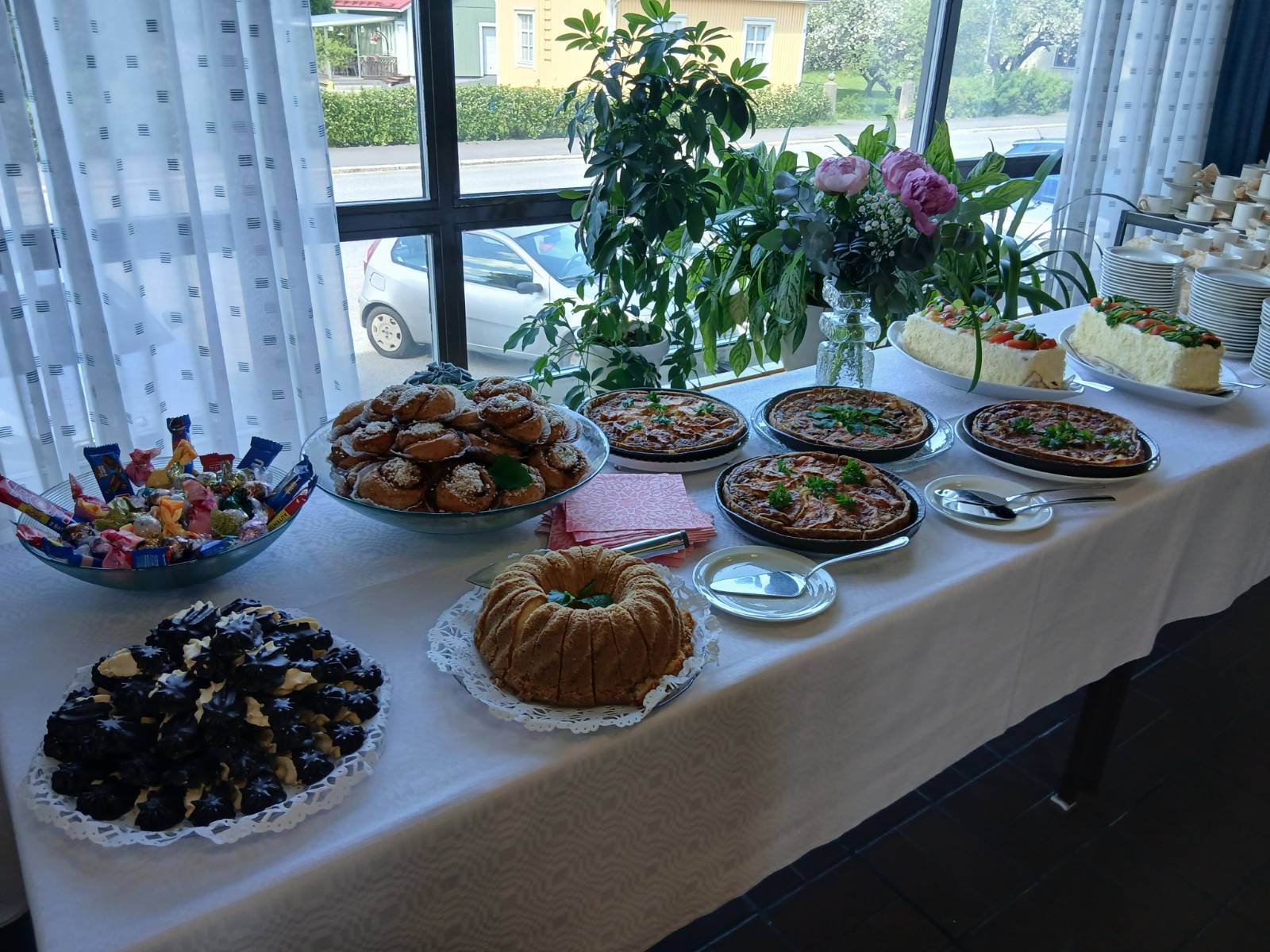
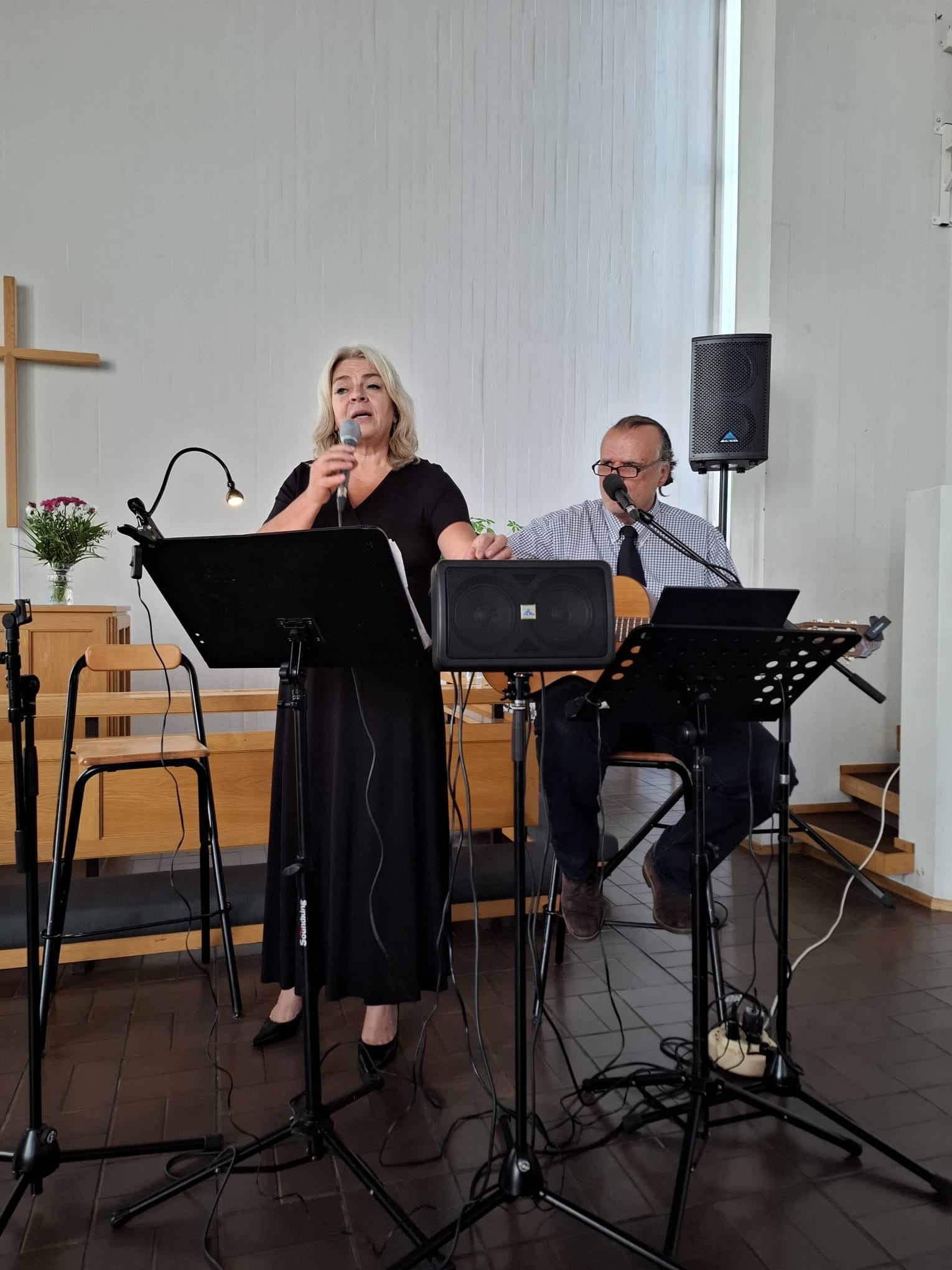
On May 23rd, we celebrated the 30th anniversary of our association at the Poltinaho Community Center in Hämeenlinna, together with approximately 60 friends. Moderated by Jarmo Majamaa, we heard moving speeches, a look back at the association’s history, reports from staff members, and reminiscences and greetings from our partners. Ulla and Pete Ronkainen delighted the audience with Christian and Hebrew music. The keynote address was given by a friend of the Huber family, Pastor Klaus Korhonen. Since many of you, dear friends of our work, were unable to attend the celebration, we would like to share Klaus Korhonen’s keynote address, as well as the greetings from Ulla Järvilehto and Janina Ilie, with you.
Speech by Klaus Korhonen:
Dear guests, dear members and friends of the Eeva Huberin Tuki Association!
The celebration we are holding today fills me with a deep sense of awe. Awe for the life’s work of Eeva Huber, but also for all those who, for the past 30 years, have been realizing the vision of helping persecuted Jews. I admire your perseverance, Hannu and Anne Ylitalo, and that of all of you who carry on the responsibility for Eeva’s life’s work in so many different ways. I also remember with respect Yrjö and Pirkko Ingman. I’m sure they would be pleased to know that their daughter and son-in-law are participating in this celebration today.
I have been in contact with the Huber family’s children, Samuel and Tamara, who live in Vienna. Both asked me to convey their greetings and their deep gratitude at this celebration. Tamara wrote: “It is by no means a given that, so many years after our parents’ death, friends in Finland still hold the people we support as an association in their hearts.”
When we speak of Eeva Huber, it would be impossible to speak of her alone. Her better half was Adalbert, called Berti. The two complemented each other wonderfully. I once described them as down-to-earth dreamers. Perhaps dreams and visions were more Eeva’s strength. When it came to the practical implementation, Berti, with his many talents, was an irreplaceable asset.
Allow me to say a few words about the Hubers as our family friends. It was a sunny late summer day in 1975 when we arranged to meet in the center of Vienna at the Maria Theresa statue. Eeva and Berti arrived there hand in hand as a young couple. This marked the beginning of our decades-long friendship. It was strengthened by our children, who were the same age, and whose bond continues to this day.
The Hubers’ house was open to countless guests, especially those working in the Kingdom of God. Their home was filled with joy and activity. Eeva was concerned about the spiritual situation in Austria and wrote about it in Finnish newspapers. She was actively involved in the ministry of the organization “The Gospel in Every Home” and led a Bible study group for Finnish women in Vienna.
Eeva and Berti supported us in many ways in the founding of our independent Christian church and even participated in the church’s 30th anniversary celebration shortly before their departure for Romania, where they tragically died. They were always ready to help, whether it was picking up guests from the airport, finding accommodation, or assisting with other practical matters.
If I were to look to the Bible for a parallel to Eeva’s personality, Esther, whose story you all know well, would come to mind. The climax of the Book of Esther is not her rise to a high social position. A book would hardly have been written about that. Jews have held high social positions throughout history. The climax was the challenge of becoming the savior of the Jewish people. When the Jews were threatened with mass murder, Esther’s foster father Mordecai asked her a question that placed a great responsibility upon her: “Didn’t you come into your position precisely for this moment?” Precisely for this moment.
Eeva possessed the special gift of recognizing the unique opportunities of her time—perhaps even of seeing further into the future than many others. In the early 1980s, Eeva began to grasp the fate of the Jewish people, a topic that was considered a heavy burden of recent history and was preferably ignored in Austria at the time.
Eeva encountered individual Jews who had learned to remain silent about their past and conceal their concentration camp tattoos under their sleeves. Eeva wasn’t content with mere sympathy; she began to investigate the underlying reasons. Not everyone understood her, but Eeva was not discouraged.
When Russian Jews streamed into Austria in droves, Eeva and Berti resolutely rose to the challenge. Together with friends, they established the reception center on Schüttelstrasse in Vienna. Tens of thousands of Jews received assistance there, such as clothing and food, to continue their journey to Israel or other countries. Many Finnish friends were involved in this work.
My own unforgettable memory is connected to a winter day I spent in Vienna. A cold wind blew through the streets. Eeva was showing me the work center when a slender, shivering Jewish woman entered. Eeva dressed her in warm clothes. I remember how happy they both were.
The commitment of the Huber family and the aid association we are celebrating today for Jews in Romania and other Eastern European countries was of great importance. After the Holocaust, thousands of Jews remained in Romania, many of them malnourished, living in cold apartments or sheltering in destroyed synagogues.
Countless aid shipments went to Romania then and continue to this day. They were not only emergency relief, but also expressions of love that meant a great deal to many people who had experienced hatred and rejection, and even restored their human dignity. When I think of you, Hannu and Anne, and of the others who were involved in this work, I can only begin to imagine the human tragedies you encountered. Or how many arduous and dangerous journeys you undertook, how many sleepless nights you spent.
Esther in the Old Testament rose from one of the unknown orphan girls among the displaced to a position of importance. Eeva, too, initially held no position of importance, but she had all the more determination. The significance of her life’s work is evidenced by the gold medal of honor awarded to her by the Austrian state in 2006, as well as by a Viennese rabbi’s description of Eeva as an “Angel of the Jews.”
The Book of Esther is unique in that it makes no mention of God. Nevertheless, the narrative of God’s care and faithfulness runs through the entire book in the background. God appointed people who were willing to take great risks for the people they loved.
Eeva and Berti did not spiritualize practical matters. They did what they could—unobtrusively, out of love.
The Esther of the Bible accepted the challenge from her foster father Mordecai to set out to defend her people—fully aware that she was risking her life. Perhaps the decision would have been easier if she had known that the rescue mission would succeed—or that she would still be spoken of thousands of years later all over the world. But she did not know. Esther’s answer was: “I will go… if I perish in the process, then I perish.”
This attitude requires inner strength. The awareness that the greatest task of a human life can arise from a response given at the right moment. Not that I seek my own life, but that I am willing to lose it to serve others—just as Jesus taught (Matthew 16:25).
A decision made in a fleeting moment can be greater than a human life.
Eeva and Berti served until the very end. Their missionary service ended tragically on April 18, 2008, in Transylvania, Romania. This was a profound loss for all of us. My wife and I have often found that we still miss them. But could there be a more beautiful ending: They were just beginning to bring help to those who had lost everything, to the forgotten Jewish elderly.
The association “Eeva Huberin Työn Tuki”—you, dear friends—are proof that Eeva and Berti’s life’s work lives on.
Esther’s book tells how a man named Haman sought a way to annihilate the Jews. Today, Haman’s shadow, antisemitism, once again looms over the Jews. Esther risked her life. Eeva and Berti did the same. We as Christians today also bear responsibility for our Jewish neighbors.
Eighteen years ago, when we held the memorial service for the Hubers in Eeva’s old home parish of Saalem in Helsinki, I summarized the calling of Eeva and Berti Huber with the words of Isaiah: “Comfort, comfort my people, says your God.
Speak tenderly to Jerusalem, and cry to her that her warfare is ended, that her iniquity is pardoned” (Isaiah 40:1–2a).
I would like to share these words with all of you who, in your various ways, have continued the life’s work of Eeva and Berti Huber.
Thank you for all your work and effort. Thank you for the comfort you have given. Thank you for your manifold help, which was a quiet, loving message to our Jewish fellow human beings.
I wish you God’s blessing, strength, and guidance for the future as well.
Klaus Korhonen
***
Speech by Ulla Järvilehto:
Dear friends of the work of Eeva Huber and her family!
I wish you a joyful and blessed 30th anniversary of your work. You are truly blessed people, for the Lord has promised in His Word to bless those who bless His chosen people, and He does not break His promises.
I had the pleasure of meeting Eeva in the early 1980s, when the winds of change began to blow somewhat more freely in the Soviet Union with the so-called Perestroika. This also facilitated the increasing emigration of Russian Jews to their homeland of Israel. At that time, the only transit route through Europe led through Vienna, where Eeva lived with her family. Vienna was also home to a branch of the Israeli immigration authority, Sochnut—at that time, the only one in Europe.
Suddenly, a constant stream of new Russian-Jewish immigrants was arriving in Vienna, each allowed to bring only one suitcase with belongings and 100 rubles. They had to make do in a foreign country. Many didn’t even have proper shoes.
In 1984, I had just founded the Finnish section of the ICEJ, the International Christian Embassy Jerusalem, together with some friends. Eeva contacted me and told me about the great need for assistance among the resettlers. She said that the Austrian communities at that time hadn’t yet opened themselves up to working with Jews, and that the need for help among those passing through was urgent. So we made Eeva’s work one of our first aid projects.
From the very beginning, I felt and saw that Eeva’s work was a blessing. It was as if the Heavenly Father smiled upon us as we were allowed to proceed with the actions He had previously prepared. Many memories are indelibly etched in my mind, for example, this one: Eeva called and said that warm winter clothing and shoes were urgently needed. We spread the word and soon sent Eeva a container with the requested supplies via a shipping company. We were still a young organization, and our accounts had barely accumulated any money. However, we decided to ship the container as soon as possible and see where we could raise the money when the shipping company’s bill arrived. The following Sunday, I was on a speaking tour in Satakunta, where my topic was “Israel and Biblical Prophecies.” I didn’t mention the shipping or the need for funds. After the meeting, the local pastor approached me with a brown envelope in his hand and said, “I don’t understand this at all, but an elderly woman from my congregation gave it to me and said, ‘Give this to Ulla Järvilehto; she needs it for some shipping.'” I realized that the servant of the Lord had followed the Lord’s instructions precisely, because the envelope contained exactly the amount of money we needed to pay the bill.
I also vividly remember the moment when I sat with Eeva, who was on a speaking tour, in the front pew of the Free Church in Tampere, waiting for the service to begin. Eeva turned to me and said, “An elderly, disabled woman just came to us who needs a wheelchair.” I was surprised and replied, “I was with the person in charge of sending out clothing yesterday, and she said, ‘Someone sent us a wheelchair. I wonder who might need it?’” The feedback from travelers was also heartwarming. A middle-aged woman from Leningrad, who had been taught atheism her entire life in the Soviet Union, said at Eeva’s aid center, “Here I feel that God exists. God is present in everything you do here.”
Eeva Huber is estimated to have helped 60,000 Jews on their journey home to Israel. She deservedly received the Austrian State Prize for her work. Israel, too, has recognized her work. Representatives from the Diaspora Museum in Tel Aviv visited her to interview her and document her work, which is now also “immortalized” in the Diaspora Museum in Tel Aviv.
Times change, and work changes, as it must when needs change. In the beginning, the work consisted almost exclusively of exodus work. The transit route via Vienna, as well as other routes opened later, including the transit route via Finland, has become less busy, since direct flights to Israel from the countries of the former Soviet Union are now available. Now, the work initiated by Eeva Huber—HELP and HOPE—consists mainly of supporting elderly Jewish people and needy communities in Eastern Europe, but its goal remains the same: the well-being of the Jewish people.
The work initiated by Eeva Huber did not end with Eeva and Berti’s sudden passing during their aid trip to Romania in 2008. I am delighted that the younger generation of the Huber family has taken over the leadership of this work. For this, I bless you, dear young Hubers. I am also delighted that Finnish friends have continued to support and promote this work. For this, I bless you, esteemed guests. This is a wonderful collaboration.
If you are ever threatened with exhaustion, then, for your joy and as a source of life, remember what our beloved Savior, the Jew Jesus, said about you: “Come, you who are blessed by my Father—for I was hungry and you gave me something to eat, I was thirsty and you gave me something to drink, I needed clothes and you clothed me—whatever you did for one of the least of these brothers and sisters of mine, you did for me.”
Heartfelt congratulations and blessings,
Ulla Järvilehto
***
Our partner Janina Ilie from the Union of Jewish Communities of Romania and the organization Alef in Bucharest attended the celebration and conveyed personal greetings.
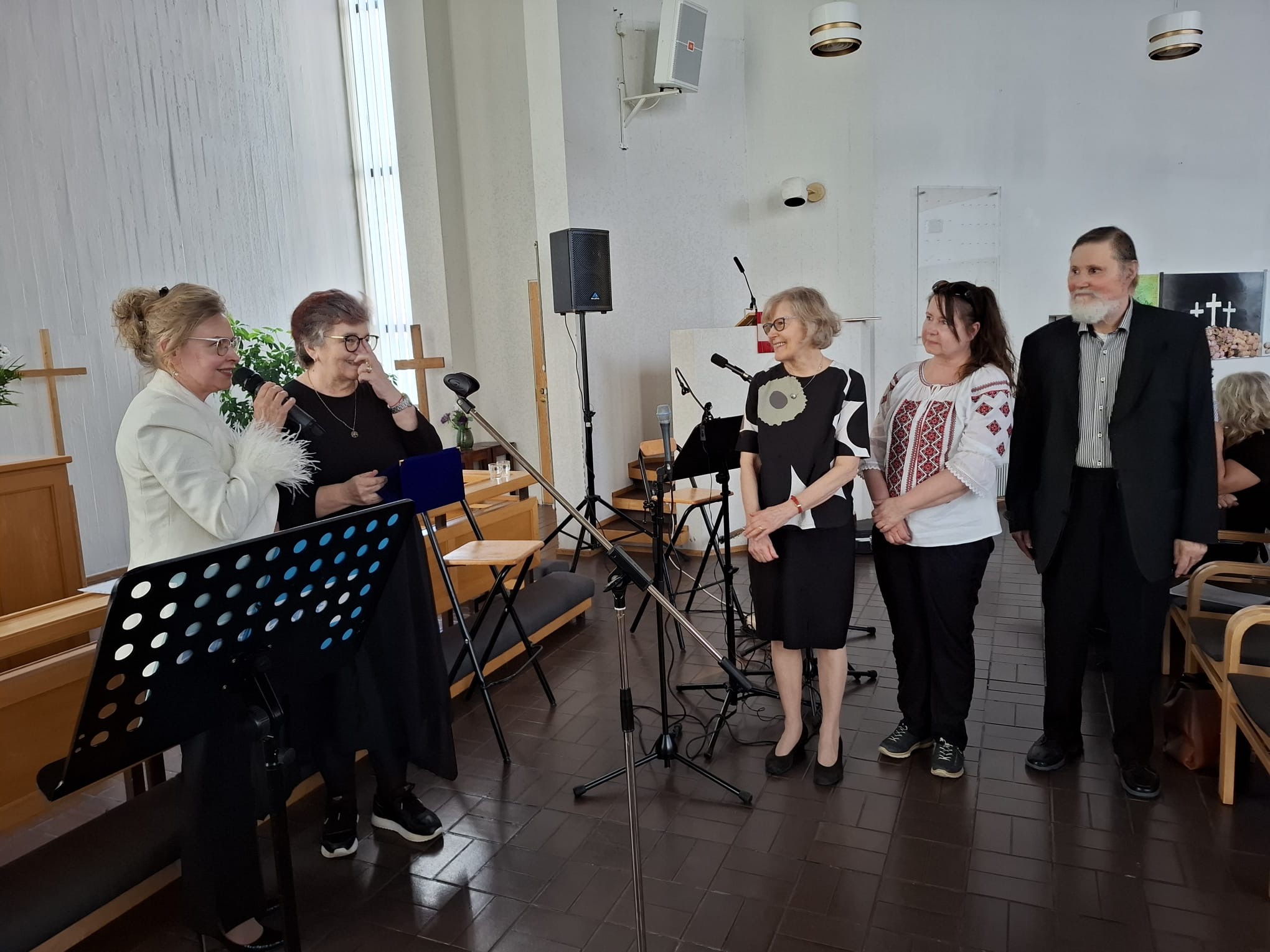
From left: Anne Ylitalo, Janina Ilie, Hanna Rantavaara, Ilona Turunen, Jarmo Majamaa.
Speech by Janina Ilie:
Distinguished guests, dear friends,
there are moments when words are insufficient to express the gratitude we feel. And this anniversary is one of those moments.
Thirty years of service means more than just institutional continuity. It means three decades of care, taking responsibility, and solidarity translated into action. It means thousands of small but essential gestures with which you have changed people’s lives and brought light to places where there was fear, hardship, or uncertainty.
For Romania, and especially for the Jewish communities, your presence and support have been a true lesson in humanity and friendship. You came to us not with an air of superiority, but with respect for us—not with grand pronouncements, but with deeds. You learned the life stories of many Holocaust survivors. You said that wounds become scars and can only heal when these people experience the support, friendship, and respect of people like you. And you helped—not out of a sense of duty, but out of the deep conviction that people must stand by one another.
On behalf of the Alef Association for Education, Culture, and Development, which I have the honor of leading, I would like to express our deep and sincere gratitude. The support from your organization has meant more to us than just concrete help for our projects. It has meant trust. It has meant hope. It has meant the feeling that, no matter how difficult times may be, there are people who choose to build something, to support others, and not to remain indifferent.
I would like to publicly thank my dear and good friends Anne and Hannu Ylitalo, Eeva Virola and Jarmo Majamaa, Ilona from Turku, Hanna Rantavaara, and all of you. I bow in deep respect to the women who knit socks for the residents of nursing homes, and to all those who helped ensure that Jewish children received Christmas presents. Thank you so much!
Behind every project we’ve undertaken together are faces, stories, and destinies touched by your kindness. These are people who have found the courage to hope again. Children who have been given new opportunities. Families who have felt they are not alone. And all of this cannot be measured with statistics or reports. It lives on in the hearts of those you have helped.
The true value of an organization lies not only in what it builds, but also in the trust and dignity it leaves behind. And that is precisely what you have achieved over the past 30 years.
Today, on this special day, we are not only celebrating the history of a significant organization. We are celebrating the bridge between Finland and Romania. A friendship built on generosity, respect, and shared values. We are celebrating people who have chosen to transform compassion into action and solidarity into hope.
We thank you for everything you have done for our communities and the Alef Association.
We wish you many more bright and inspiring years to come. We hope you have the strength to continue this extraordinary work and remain a role model of generosity, dignity, and humanity for many generations to come. Congratulations on your 30th anniversary!
And from the bottom of our hearts: THANK YOU.
Janina Ilie
***
We thank God for all of you who are friends of our association. Together, we have brought help and hope to those in need – for 30 years now! Thank you so much for your loyalty!
On behalf of the HELP and HOPE team, we thank you and send our warmest regards.
Anne and Hannu
(June 2026)