
The recipients of this year’s Hanukkah gifts were elderly Jewish people living in Bucharest. We prepared a total of 70 gift bags, as well as some personal packages and sweets for children. The project was carried out in cooperation with the organization Alef.
The roads are now mostly well-developed, but there are still some sections on the Romanian side where there is no highway and the direct route leads through small villages. There are also many construction sites along the way, which make travel difficult.
Hannu’s journey began on the evening of December 3rd (Wednesday), and he arrived on Friday morning after two nights. Anne arrived by plane on Friday at noon due to her work schedule. The weather was damp, rainy, and cool throughout. On Friday, we stayed overnight in the accommodations of the Great Synagogue (Sinagoga Mare) in Bucharest.
This apartment was once home to Rabbi David Moshe Rosen, who was one of the most important rabbis in Romania during his time. He was born on July 23, 1912, and died on May 6, 1994. In 1940, he was appointed rabbi of the city of Suceava, but after September 6, 1940, when the Romanian far-right Legionaries of the Archangel Michael (Iron Guard) came to power, Moses Rosen was arrested as an alleged “communist” and deported to an internment camp in Caracal in southern Romania. After the Legionaries were defeated several months later by the troops of Prime Minister Ion Antonescu, Rosen was released and worked as a part-time rabbi at two synagogues in Bucharest, Reshit Daat and Beit El. At the same time, he taught the Talmud at a Jewish school.
Romania’s entry into the war against the Soviet Union as an ally of Nazi Germany brought further difficulties for the Jewish population. Rosen had to go into hiding to avoid deportation to Transnistria, as he was falsely considered a “leftist” or “Bolshevik-Jewish activist.” After the coup of August 23, 1944, which led Romania to abandon its alliance with Hitler and end fascist-antisemitic rule, the Jews were given their freedom, and Moses Rosen rose through the ranks of the Bucharest rabbis.
He served as Chief Rabbi (Rav Kolel) and head of the Jewish community of Romania from 1948 to 1994, and as head of the Union of Jewish Communities of Romania from 1964 to 1994. He led the community throughout the communist era in Romania and remained in his position even after the restoration of democracy following the Romanian Revolution of 1989. In 1957, he became a member of the Romanian Parliament (Grand National Assembly) and retained this office during the communist regime and after 1989 in the democratic parliament. In the 1980s, the Romanian authorities granted him permission to acquire Israeli citizenship, and he was elected chairman of the board of the Jewish Diaspora Museum in Tel Aviv.
Some prayer services continue to be held in the premises of what is now the Sinagoga Mare, and in 2010, the Romanian Holocaust Museum opened there. It was only at the beginning of the 21st century that Romania officially acknowledged the persecution of Jews in Romania, which led to the establishment of the museum. The synagogue was built in 1846.
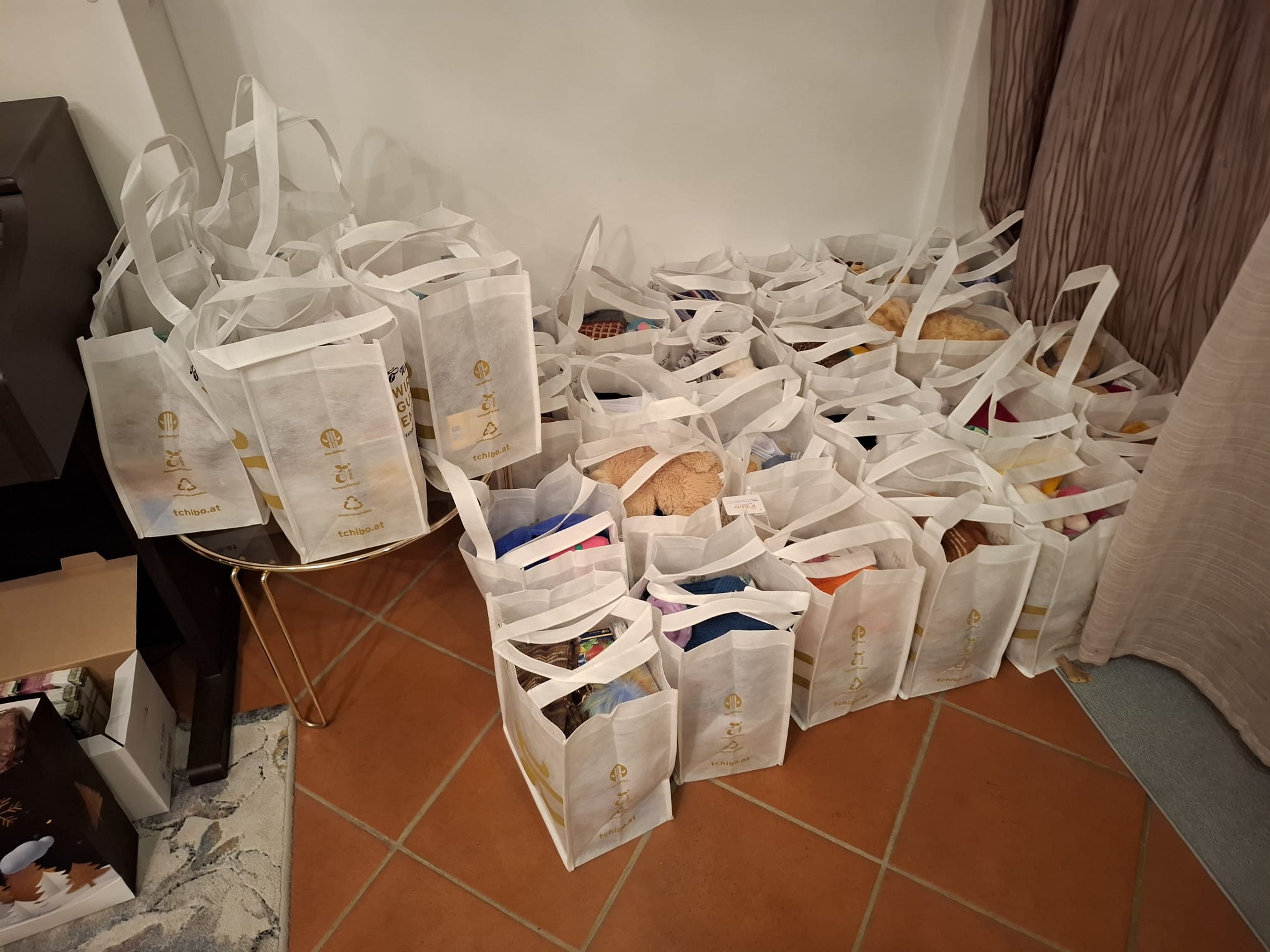
We brought the bags and other donations to the main synagogue (Choral Temple) at 6:00 PM on Saturday after Shabbat, where they were distributed to the elderly members of the community. Three nimble men from the community helped us unpack the bags in the drizzle.
The gift bags contained coffee, tea, sugar, cookies, chocolate, napkins, and candles, as well as Finnish wool socks and a psalm greeting.
Before his flight home, Hannu met a Messianic pastor we’ve known for years at a nearby kosher restaurant on Sunday afternoon. This restaurant and a nearby café opened about a year ago in anticipation of a return of more tourists from Israel. Before the pandemic, around 20,000 Jews visited Bucharest each month.
Anne & Hannu
(December 2025)