
Helping people in need matters. Recently, I had the chance to do my part—just a small contribution, but meaningful. Hilfe & Hoffnung (H&H), a Vienna-based organization, has a simple yet powerful mission: to support disadvantaged communities in Eastern Europe. They’ve already done incredible work in Romania, where there’s no state system to care for families and individuals in crisis.
When the war broke out, Ukraine’s situation became desperate. People lacked almost everything. H&H quickly expanded its efforts to include Ukraine, organizing aid shipments from Western Europe to the East.
The Call to Action
In November, I got a message from Hannu, my cousin’s husband:
“There’s a truckload of supplies ready in Vienna. It needs to get to Ukraine. We just need someone to drive it.”
I was on vacation, so in theory, I had time. But finding someone equally crazy and suitable for such a trip? That was the challenge. Plenty of enthusiasm, but not enough time, skills, or grit among my friends.
Finally, good news: Georg, a man in Vienna, could join me. He speaks Romanian and lived there in the ’90s, a perfect travel companion for my first-ever aid delivery. Decision made: I’d leave the very next day.
Sunday morning, I set off with a sense of adventure. At the airport gate, I realized my reading glasses were gone, left behind at security. I went back, but no luck. Well, they were old anyway, and I needed new ones. As the last passenger, I rushed onto the plane and sent a quick message to Vienna. The reply came with a photo: snow everywhere. The car wouldn’t be ready until the afternoon. “It’ll work out,” I thought.
Hannu met me at Vienna airport. We drove to pick up the car, finally available. Before we hit the road, I got safety instructions and one important warning: never leave your papers or wallet in the car.
Loading Up and Hitting the Road
We drove to the warehouse where the aid supplies were already packed into boxes, over 400 kilograms in total. Mostly pet food, clothes, and toys. There had been more donations, but some had to be discarded. It’s crucial that the aid delivered is in good condition. Ukraine’s logistics system is overwhelmed, and sending broken equipment from Western Europe with the expectation that “they’ll fix it” is simply wrong. What’s needed in Ukraine: food, goods, and equipment—must be high-quality and ready to use, just as H&H ensures.
Once the car was loaded, we went for a meal together. Traditionally, Wiener Schnitzel is made from veal, but I’ve been trying to cut down on red meat. I was delighted to see that Anne had swapped the main dish for a chicken schnitzel instead.
At the gas station, I met my travel companion Georg for the first time. He’s retired now, which gives him the freedom for trips and adventures like this. Back in the ’90s, Georg worked in Romania in finance and learned the language, a skill that would prove invaluable on this journey.
And so, we set off together. Georg wanted to drive first while it was still light, and he knows the roads around Vienna well. That gave me time to set up the navigation devices. Our plan was to spend the first night in Oradea, already across the Romanian border. To get there, we had to drive through Hungary. A motorway is being built along most of the route, but much of it was under construction or still in preparation. I can’t always decide where our EU funds go, but travel broadens the mind, and I like seeing firsthand how the money is spent.
The hotel in Oradea was easy to find and surprisingly affordable for what felt like a luxury stay. After a long drive, sleep was more than welcome.
Through Romania: Contrasts and Challenges
The next morning, refreshed, we set off again, but not before taking a stroll through Oradea’s old town. The city center is beautiful, with well-preserved buildings, though some were still under renovation. On the side streets, the picture was different, houses in poor condition, many in need of repair. There’s still so much work to do. I don’t think I’ve ever seen such stark contrasts anywhere: some people live in palaces, while others struggle in rundown homes or even on the streets.
I learned that Romania officially has about 23 million people, but many work abroad—in Austria, Italy, Germany, and across Western Europe. Back home, grandparents often raise the children while parents earn a living elsewhere. In rural areas, you can see houses being renovated, perhaps in hope of returning one day. But as darkness fell around 5 p.m., it was clear that most homes were empty—only a few had lights on.
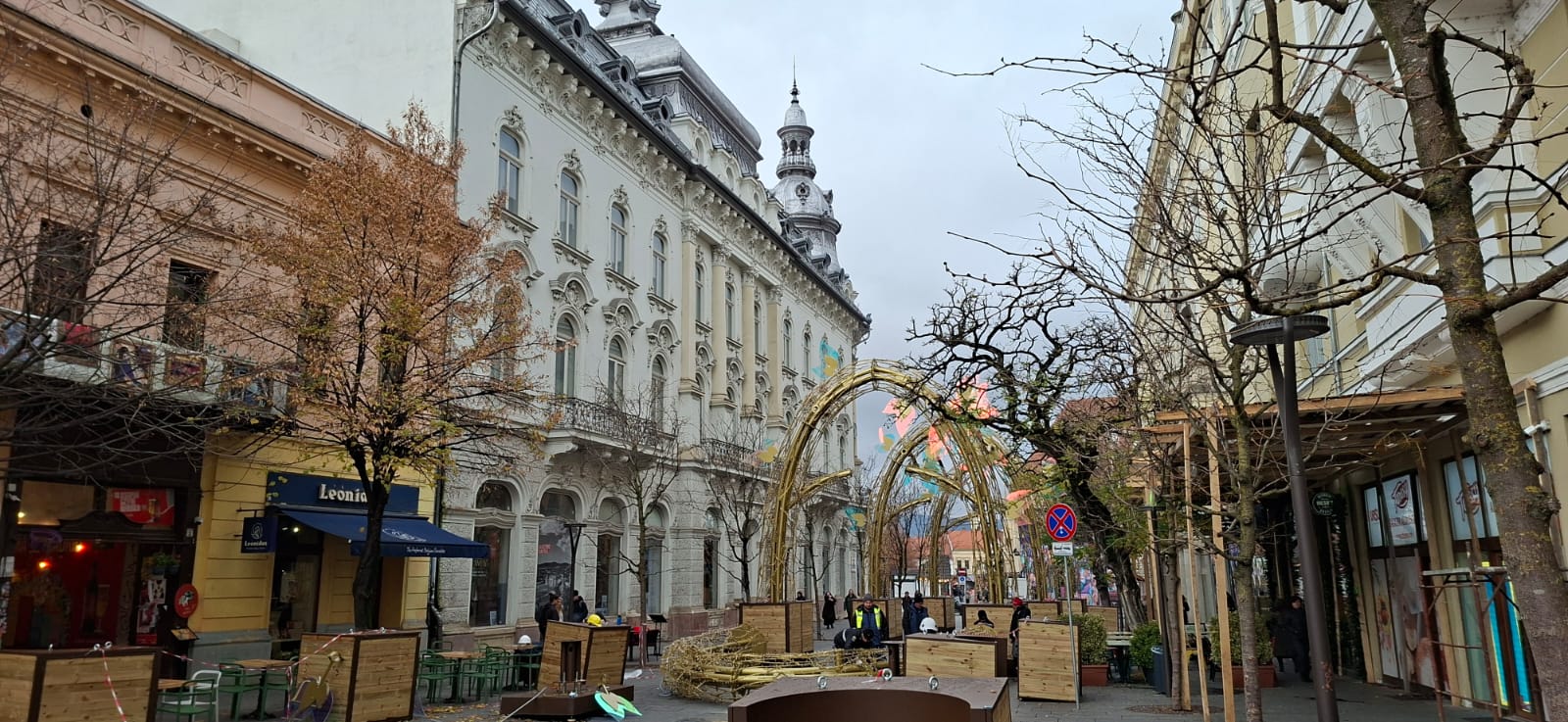
On the way, we stopped in Cluj-Napoca, a city founded by the Romans. Its long history is visible everywhere, statues on every square, including one of King Matthias Rex, who united Hungary and Romania. Apparently, he ruled well, since his statue has never been torn down. Monuments to great figures are everywhere. Nicolae Ceaușescu’s statues, however, are rare, though some still speak fondly of him. Southern Romania was once under Ottoman rule, too. I thought to myself: one day, I need to visit Bucharest and dive deeper into this fascinating, layered history.
Driving in Romania is chaos. Like in many developing countries, things happen in the wrong order: first, people buy cars; then they start fixing roads; and only later do they think about parking spaces. Roadworks slowed us down often, when a bridge or road was under repair, one lane was closed. Our longest wait was 45 minutes, and there were several stops. What struck me was how calm the locals were, no sign of the Western impatience I felt creeping in.
As night fell, we stopped for fuel. As a Western tourist, I didn’t know the drill—I should have known in advance how much to pump. Eventually, the attendant came out and did it for me. That’s when I learned my first Romanian word: diesel is “motoriină.” To me, it sounded more like the name of a female mechanic than a fuel type! The evening grew colder. By the time we crossed the Carpathian Mountains, it was freezing. The road was dry, but snow lined the edges. I let the locals pass me on the winding mountain roads. It was a challenging drive, but spectacular. I thought: I have to come back here—next time in summer, and on a motorcycle.
The Final Stretch: Delivering Hope
Late Monday evening, we finally reached our destination, the border town of Rădăuți. Our insurance didn’t allow us to cross into a country at war, so the plan was for Ukrainian contacts to pick up the supplies here. We found our reserved hotel without trouble, and everything went smoothly. The arrangement was simple: the goods would be collected from the hotel parking lot the next morning.
On the way, we learned that our original contact, Tanya, couldn’t make it. Instead, Nadja and Stefan would come. I had their photos, so recognizing them wasn’t a problem, a relief, since I’d heard stories of aid shipments being stolen and sold for profit.
Once the handover was done, I invited Nadja and Stefan for breakfast. We had a brief but meaningful conversation, switching between English, German, and Ukrainian. They told us that there had been another air raid alert the previous night. Thankfully, it doesn’t happen every night, but imagine having to run to a shelter in the middle of your sleep. Both looked exhausted from the long war. It’s heartbreaking, so many have died on the front lines, and now even 18-year-olds are being called up. Nadja used to work at a hotel that went bankrupt because of the war. When peace finally comes, Ukraine will face an enormous task to rebuild and restore normal life. We all agreed on one thing: this Russian war of aggression must end—soon.
After breakfast, we started the return journey. At last, the sun was shining, and the Carpathian Mountains revealed their beauty. Romania’s roads still have a lot of catching up to do, but credit where it’s due, the mountain serpentines have been fully rebuilt and are in excellent condition.
Driving through Romania is like watching the entire history of transportation unfold. Horse-drawn carts share the road with homemade-looking vehicles, while luxury cars like Maseratis and Porsches zip past. Most cars, though, are Dacia’s and VW’s. You must stay alert, animals wander freely along the roadside: dogs, cats, sheep, cows, goats. With no guardrails, one wrong move could send you plunging into a deep ditch.
Our next stop was Oradea again. This time, we couldn’t get a room at the same hotel, but we found an apartment downtown. Parking was a challenge, and the Hotel’s courtyard looked chaotic, old roofing debris piled up. The host noticed our concern and reassured us: the rooms were freshly renovated. And indeed, they were spotless and comfortable.
The following morning, we headed for the Hungarian border. I couldn’t help but notice the vast fields along the way, settlements were rare except near Budapest. The roads are still under construction, but once complete, crossing Hungary will be a breeze.
The round trip from Vienna to Rădăuți and back is over 2,000 kilometers. The aid packages were delivered and used immediately. Three days for such a journey is tight, probably a record. Ideally, you’d allow a week to truly experience the local culture and history. There’s still so much need for help out there. This post is really just a roadside story. Hopefully, I’ll have time for more aid trips in the future. And next time, I want to write more about the people.
Juha, Finland
(November 2025)